Tuesday, September 25, 2012

Our New House!


We signed the contract for our new house today! It's in the Sakuragaoka neighborhood of Yokosuka--a lovely neighborhood up only a bit of a hill (it's a challenge in Japan to find a house in a totally flat area). It's less than a 10 minute walk from Maborikaigan station, where there are a bunch of restaurants and a grocery store, etc.

Believe it or not, it used to be a SIX bedroom house (two of the bedrooms were converted into a large living room). At approx. 1300 sqft, that is a really small six bedroom house! It was built in 1975, so it's pretty ancient in terms of Japanese houses, but it's been renovated since then.


Carport on the side

Entry with shoe closets

Our dining room, a former bedroom
Hideous bathroom...but I don't think we'll be spending most of our time in there ;)

Equally hideous tub and shower room

Giant kitchen (supposed to be a kitchen/dining room). This is by far the biggest kitchen we saw.

Note that there is no dishwasher and oven!

Kitchen storage and washer/dryer hookup


Huge living room--one of the reasons we chose this house!

Stairway is steep, but we saw steeper ones!

Master bedroom

Bathroom off master bedroom

Balcony off master bedroom--you can see Tokyo Bay a little bit

Second bedroom/office


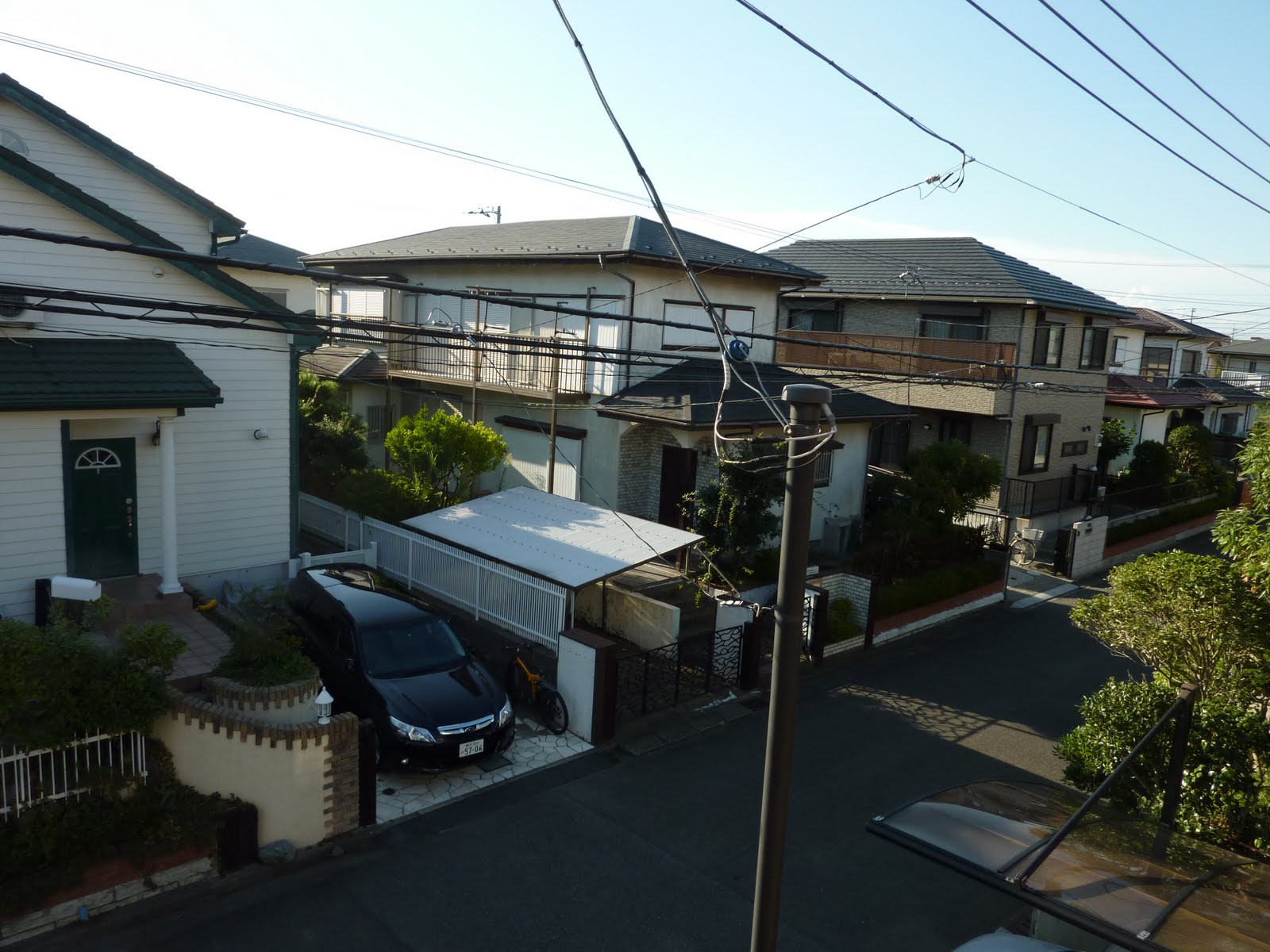
Neighbors across the street

Tatami guest bedroom


Backyard/2nd parking spot

Ready for my garden!

Sunday, September 16, 2012

Japanese House Hunting

Well, we’ve learned a lot about Japanese houses and the rental process in the short time that we’ve been here. Japan is a country about the size of California, but with almost 130 million people…and 80% of the land is mountainous. That means only 20% of the land is available for agriculture, industry and housing. Space is at a premium, which is something that is difficult to understand for most Americans.

Any house that is over 30 years old is considered ancient. At this point only the land is valuable and the house is worthless. Most houses that age have (or will be) torn down and replaced. Why build essentially throwaway houses? As far as I know, Japanese houses have never been built to last—tsunamis and earthquakes destroyed houses so many times historically that houses were built to be reconstructed quickly and often.

First of all, Japanese houses are mostly very small, but you can find decent sized houses, especially in the area we’re in (Yokosuka, which is considered part of the Tokyo Metropolitan Area). We looked at a 679 sqft apartment with THREE bedrooms (which is about the same size as our ONE bedroom back in Seattle!) but then we also saw a 1500 sqft house. Regardless, we will probably be some of the only people that will be living in a larger home than we were back in the states.

Click here to see a gallery of houses we've looked at so far.

Most of the kitchens are pretty small, so they have under floor storage. Japanese women are much shorter than me on average—probably by 5 inches or more. Therefore, the countertops can seem very low! Also, you’ll be hard pressed to find a house with an oven AND a dishwasher. Most of have neither! A stove top with 3 burners and a fish broiler underneath is standard. I would love to find a house with a dishwasher, even though they’re usually tiny—a small pull out drawer. I HATE doing dishes! Let the record show that Igor has volunteered to help out :)

The washer and dryer are always stacked and located in the bathroom (the toilet is in a separate room). Japanese dryers are pretty useless, as they can take half the day to dry one small load, plus they use a lot of energy. Most people just hang their clothes out on the line on their balconies.

A traditional Japanese bedroom has a tatami mat floor (made of woven straw). A futon is laid out at night and folded up and stored in the closet during the day. On average, bedrooms are 6 tatami in size (a tatami mat being 3’ x 6’), or 9’ x 12’. That is rather small when you consider most Americans have queen size beds, not to mention king sized! Tatami mats, while beautiful, are fragile and cannot handle heavy furniture, such as actual beds. If one is damaged, it costs about the equivalent of $600 to replace each mat, and all must be replaced so they match. One solution is to lay a carpet over the tatami.

Parking is at a premium, since space is at a premium. Some houses don’t have a parking space, some have one, and sometimes you’ll find houses with two. They are not always located next to the house—sometimes a short walk away. In the neighborhoods there is virtually no street parking. And before you get a car, the police have to come out to measure to make sure it fits properly in your spot!

All this being said, our #1 priority is to find a house close to a train station, within a 10 minute walk. Easier said than done since this is what most people want! Our other criteria include 3 bedrooms, or 2 bedrooms and a tatami room. We’d like a small yard, somewhere for me to garden and BBQ. That rules out apartments—no BBQs on the balconies since people put their laundry out there. You WILL get the fire department called out on you!

When it comes time to rent the house, you have to show up with a lot of cash--not check, not credit cards, CASH--the agent's fee, plus a security deposit and "gift money" for the owner. That all adds up to the equivalent of $10,000 - $15,000 in yen for the houses we're looking at. We have to pay this up front, but luckily the Navy reimburses us!

We'll keep you posted on how everything goes!

Saturday, March 31, 2012

An American Baseball Game in Japan

Our home team from Seattle, The Mariners, played their season opener in Tokyo at the Tokyo Dome Wed., Mar 28 against the Oakland A's. We went to go see their second game on Thurs. This is the first time that the Mariners have played in Japan (not to mention one of only a handful of times American teams have played games here) and also the first time Ichiro has played baseball in Japan after becoming a Mariner 11 years ago. He is a superstar in Japan and the stadium ignited with cheering and cameras flashing whenever he went to bat. I'm guessing the majority of people just came to see him.

I haven't been to a Japanese baseball game yet so I can't compare the game to that, but I can compare it to other games I've been to in the U.S. It was definitely the quietest baseball game I've ever been to (except for the cheering for Ichiro)! It was strange not to hear any talking, yelling, booing, cheering, or drunken shouting. Or singing--during the 7th inning stretch our group of Americans were the only ones I could hear singing along to "Take Me Out to the Ball Game"! Of course, the Japanese were unlikely to know the words.

Unsurprisingly, the stadium was also spotlessly clean. No sticky beer, sunflower seeds, or popcorn spilled everywhere--that was a big difference. Another similarity is that they did show people on the big screen, but there were no silly contests, no "kiss cam," no "Welcome to Boy Scout Troop 56" messages, no funny facts about the players, etc. So maybe the Japanese just take baseball a lot more seriously than we do and don't have the need to be constantly entertained like Americans!

At first glance, it looks like a normal game at the Metrodome!


But everything is in Japanese


And everyone is eating bento

There are cheerful "beer girls" everywhere with backpacks full of beer ready to pour you a cold one

Japanese baseball food includes yakisoba, yakitori and curry rice along with hot dogs and hamburgers
The Mariner moose was there doing some wacky dancing
And Ichiro doing his signature at bat pose
Here he is on a beer ad in left field!

Monday, March 5, 2012

Would you like furaido poteto with that?

The offerings of American fast food burger joints in Japan never fail to amuse me. They try out a lot of concepts that never appear in the U.S. (for various reasons).

McDonald's (or Makudonarudo as they call it here) is beloved by the Japanese as it is most everyone else worldwide. They have a yearly "burger series" called "Big America" (ha). They look like real gut-busters! I stick to my McChicken setto (combo meal). 

So how is Makudonarudo different in Japan? For starters, the portions are a lot smaller and the service is about 100x better than your average U.S. Mickey D's. They will run your food out to you and apologize profusely if it's not ready on time. The atmosphere is pleasant and people just hang out there too...compared to the states where the vinyl benches and obnoxious clientele make me want to take the fries and bolt.

Burger King isn't nearly as prolific as McDonald's in Japan but it's my personal fav. They seem to be playing the novelty angle by rolling out new burgers all throughout the year.The latest greatest burger combos are avocado and nacho. I got the avocado one recently (by accident), but since I'm not a huge fan of avocado it didn't do much for me. However, I am looking forward to the ringo (apple) burger this month--apples on burgers, why not?? Maybe I'll enjoy it with a Coca Cola highball (cocktail). Yes, they serve alcohol at Burger King in Japan!

Then there's Wendy's...they used to have many stores in Japan but they left the market after things fell through a few years ago. Now they're back--their first new store opened in Tokyo's swanky Otmotesando (Harajuku) neighborhood in December with swanky burgers to match. One of the featured burgers is the 1280 yen (almost $16!) foie gras burger. I don't think I can (literally) stomach that.

Wendy's Foie Gras Rossini burger


Saturday, February 18, 2012

Setagaya Boroichi

We visited the Setagaya neighborhood in Tokyo to take in the Boro-ichi street fair there. It has taken place every Dec. 15-16 and Jan. 15-16 for the last 400+ years. It's named for the rags (boro) that were sold to bind sandals way back when. Now they sell just about everything but the kitchen sink.

For mochi pounding

Masses of green tea

Anyone in the market for a naked baby statue?

Grilled rice snacks

Furry shoes that look like...well, I won't say it ;)

Sturdy teapots

Used obi (kimono sash)

Chopsticks of all kinds

Tiny dried flower arrangements

Kokeshi and other dolls  (we bought the red one)

Used geta (Japanese clog sandals)

Tiny cacti

Tuesday, February 14, 2012

Yuzu Cha

We found out we got yuzus from the grocery store and not oranges when we tried to eat one.Yuzu is an Asian citrus fruit usually used for its juice and fragrant peel. They look very similar to oranges (see left), but they are very sour, like a grapefruit and light green inside with lots of seeds.

Well, I didn't want to waste them, so I had to figure out wheat to do with them. I found a recipe for yuzu cha (tea) that I had had at a coffee shop. I juiced and chopped up the rest of the yuzus for that--delicious and smells heavenly!


Boiling sliced yuzu peels, juice, and sugar--reduces down to a jam consistency


Making the "tea"